
A novel way of measuring high magnetic fields, fundamentally different from anything previously possible
The EXAAQ measurement principle is based on room-temperature cesium atoms. These atoms are stored in a small, vacuum-tight glass container called an atomic vapor cell. Inside the cell, the atoms move around freely as a thin gas, behaving like nearly ideal individual quantum systems.
The atoms exhibit particular resonances, which appear as absorption of laser light at specific frequencies when a laser beam passes through the vapor cell. Importantly, these resonances depend directly on the magnetic field. Thus, by measuring the absorption frequencies of the laser light, the magnetic field can be directly determined.
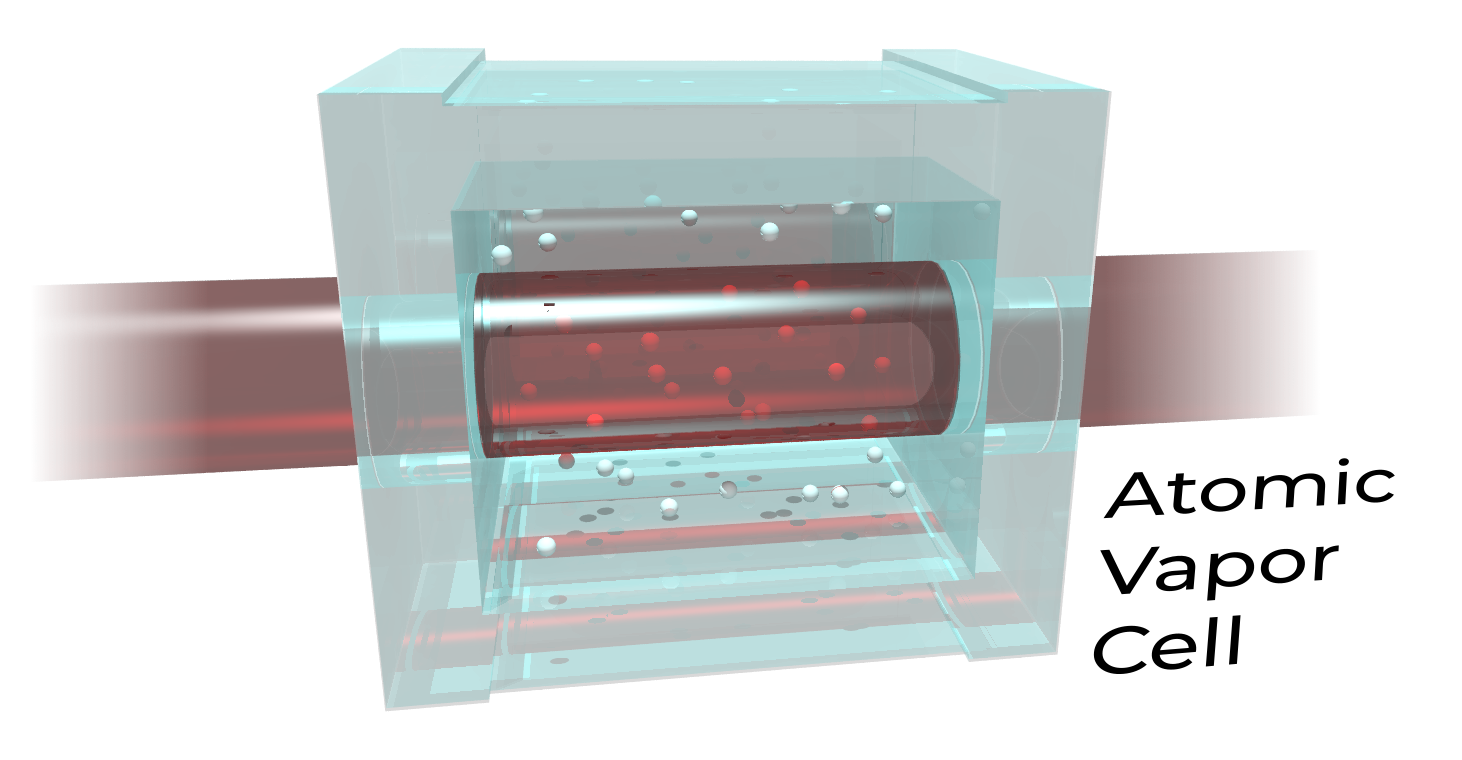
One particular resonance in cesium atoms occurs between the quantum states of maximum total projected spin, known as the extreme angular-momentum states. This resonance has a very simple and well-determined magnetic field dependence and is therefore highly suitable for magnetometry. For these reasons, the method is called EXtreme Angular-momentum Absorption-spectroscopy Quantum (EXAAQ) magnetometry.
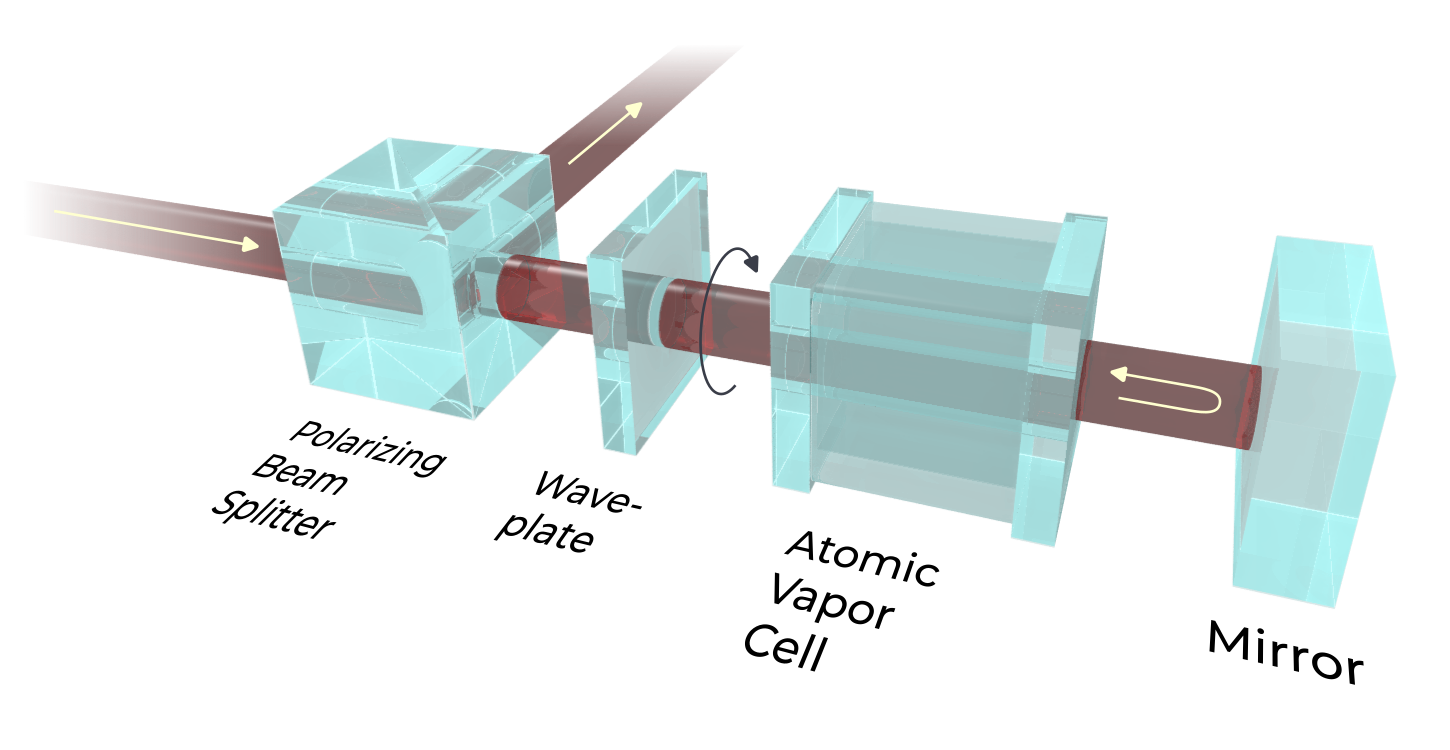
To make EXAAQ sensing practical and to suppress Doppler broadening, our technology employs an important technique called saturated absorption spectroscopy. With this technique, the laser beam passes through the vapor cell twice, addressing only the atoms with zero longitudinal velocity. This effectively makes the signal as accurate as if the atoms were cooled to near absolute zero temperature.
This approach ultimately boosts the magnetic field sensitivity by about two orders of magnitude and also enables the construction of simple, compact probes.
To implement saturated absorption spectroscopy, a polarizing beam splitter, a waveplate, and a mirror are arranged around the atomic vapor cell. This optical layout manipulates the light into the necessary circular polarization and ensures that the light is transmitted through the full setup without unnecessary losses.
The fundamental physics and practical engineering are described in the following open-access scientific articles, which can be explored for details on how the technology works.